- Excavator's profile, introduction, details, application, history, classification, tips and notes are included on this page.
-
Also known as 'earth mover' or 'excavating machinery', Excavator is a machine use a bucket to excavate materials (such as soils), or move it to another place.
Excavator is called 'Pelle' in French, 'Bagger' in Germany, '挖掘机' in Chinese and 'Graafmachine' in Netherlands.
It is often used for digging of soils and for loading dump trucks in construction project, utility work and or paving, where large amount of earth materials need to be dug and moved.
Using a Hydraulic power from a Hydraulic system, Excavator control the mechanical arm to complete the excavating job.
Excavators is one of the most important construction machinery in engineering construction.
-
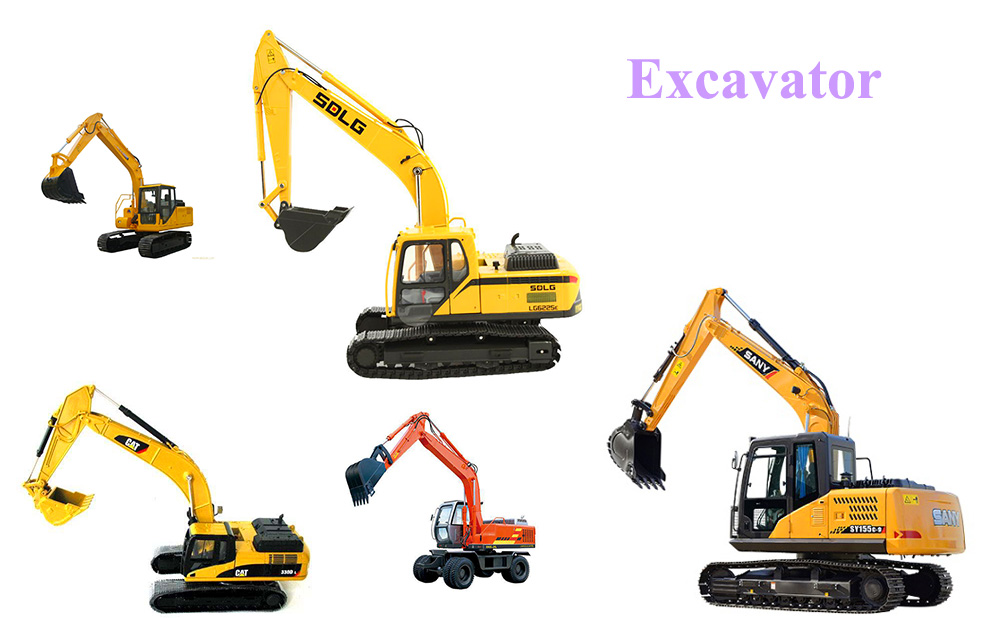
- General excavators image are presented in the photo.
-
When you need to lift or move plenty of soil, excavator is a must equipment.
Equipped with boom, dipper, bucket, and cab, Excavator is a heavy-duty machine to operate loose material based on rotating platforms on wheel or crawler.
These components of excavator provides powerful digging and lifting ability, allowing this heavy equipment to perform a variety of functions, such as loading, unloading, excavating, digging, paving, moving or even demolishing.
The three most important parameters of an excavator covers operating weight (mass), engine power and bucket capacity.
There are many kinds of excavator available based on above parameters. You should make clear the usage of the excavator before buying.
Usually, small excavator are wheel mounted, huge excavator are crawler mounted. -
Being a machine with powerful and self-propelled on wheel or caterpillars, excavator can perform spectacular operations of excavation.
New generation of excavators are equipped with hydraulics, automation, electronics, as well as computing ability. The performance of new excavator is much improved than the old generation
Performance of excavator can be measured by the production cycle: load the bucket from source, swing, dump, return back and then load again. - Mining
- Excavator is heavy machinery used in mining operations, particularly surface mining. Several types of excavator are commonly used in surface mining operations, including backhoe excavators, power shovels, bucket wheel excavators, and dragline excavators. They mainly aims at a continuous digging and transfers loose materials out.
- Road construction
- Excavators and backhoes are necessary in large project of road paving. Excavator can dig earth, load, dump and pave in road project. So it offers great help when the foundation for the pavement needs to be dug deep. An excavator gets the job done more efficiently than a large team of manual diggers. On the other hand, excavator can break through damaged asphalt concrete layers in order to make the lower layers out before pouring a new, flat layer of asphalt.
- Building construction
- Excavator can be used for excavation, heavy lifting, river dredging, cutting. Dragline excavator is another piece of heavy equipment used in the construction industry. Equipped with long-length boom and a digging bucket, Dragline excavator is generally used for larger depth excavations. Backhoe is another widely used piece of earth-moving equipment used in construction.
- Demolition
- Excavator is powerful enough for demolition of a building not very big. Mechanical demolition by excavator is safe and quick. However, it is important to consider of the building is easily accessible by the excavator.
- River dredging
- River dredging is a form of river restoration and maintenance. A normal excavator can only complete the river dredging job after the water dried or pumped out. Amphibious excavators is designed to work in swamp area, wetland, shallow water and other soft terrains. If the river is very deep, then the excavator need to be equipped with additional pontoons on undercarriages.
- Forest mulching
- Excavator mulcher is designeed to work on mulching trees, brambles, branches, shrubs and grass. It cut and chop or grind vegetation into particles, which usually left on-site as mulch.
Excavator disc mulchers are specially designed for reclaiming and deforestation, particularly in steep areas like riverbanks, power lines or pipelines. Excavator mounted mulchers can complete job on steeper slopes. -
The following standards contain provisions which, through reference in this text, constitute provisions of this International Standard. At the time of publication, the editions indicated were valid. All standards are subject to revision, and parties to agreements based on this International Standard are encouraged to investigate the possi- bility of applying the most recent editions of the standards indicated below. Members of IEC and IS0 maintain registers of currently valid International Standards.
IS0 3450: 1985, Earth-moving machinery - Wheeled machines - Performance requirements and test procedures for braking systems.
IS0 6014: 1986, Earth-moving machinery - Determination of ground speed.
IS0 6015: 1989, Earth-moving machinery - Hydraulic excavators - Methods of measuring tool forces.
IS0 6165:1987, Earth-moving machinery - Basic types - Vocabulary.
IS0 6746-1 : 1987, Earth-moving machinery - Definitions of dimensions and symbols - Part I: Base machine.
IS0 6746-2: 1987, Earth-moving machinery - Definitions of dimensions and symbols - Part 2: Equipment.
IS0 9249:1989, Earth-moving machinery - Engine test code - Net power. IS0 5010: 1992, Earth-moving machinery - Rubber-tyred machines - Steering requirements.
-
- Complete the impossible job by manpower. The power of human is limited; but the hydraulic power of an excavator is much powerful.
- More efficiency : Equipped with bucket and Hydraulic power, an excavator can more large amount of earth on truck within very shor time, which impossible by one people.
- Reach further place : The long arm of excavator can reach a further place on building or deep in a hole to complete the job.
-
- Expensive. If you need an excavator of your own company, you have to pay more than 10 thousand USD for an excavator before using it.
- Training. The driver of an excavator needs a comparatively long time to learn the driving skill before using it to complete a job.
- Maintenance. The machine need to be repaired or maintained in time, which needs additional cost.
-
- In 1796, Steam shovel was invented, which was regarded as the prototype of excavator.
- In 1839, The Otis steam excavator is the first patented excavator with a mechanical boom, which boosts the development of mining and construction industry.
- In 1897, Kilgroe Machine Co.LTD invented a steam excavator, but the mechanical boom was powered by hydraulic system.
- In the 20s, excavator was set up on tracks or wheels, which increased the mobility.
- In 1925, Bucyrus 120-B was invented, which is the first excavator can rotate 360°.
- Bucyrus RH400 was the largest excavator, which is 32 feet tall, 24 feet wide and weighs 980 tons. It can move 9,000 tons of material per hour.
- During world war two, excavators was used to dig trenches during the war and rebuild building after the war.
- Many new type of excavators was invented, most of them are equipped with hydraulics, automation, electronics, as well as computing ability.
- Landing Method
- Crawler Excavator and Wheel Excavator are both available.
Desinged for hilly, slippery or wet place, Crawler excavator runs on two tracks (chain wheel system), which spread the pressure on a larger area. It is also used where soil support is weak.
Wheel excavator is equipped with traditional wheels same with other vehicle. It is only available on dry plain ground. - Size
- Excavators are available from huge ones, normal ones and mini excavator.
Huge excavators are designed for large material moving project. It can move material at a very high efficiency. Bucyrus RH400 is 32 feet tall, 24 feet wide and weighs 980 tons. It can move 9,000 tons of material per hour.
Normal excavators weights 10 to 50 tons. It is the main products on market; and it can complete most excavating job.
Mini excavator is designed within 10 tons. It is a good choice when you excavate in a limited space, or the material is limited. The mini excavator is helpful to reduce buying and maintenance cost. - Place of origin
- The main manufactures of excavators are available in North America, Europe amd Asia Pacific.
- Bucket Type
- According to the bucket type, excavator can be divided into shovel excavator, backhoe excavator, dragline excavator and grab shovel excavator.
Front shovel excavators are mostly used to excavate materials above the surface.
Backhoe excavators are mostly used to excavate materials below the surface.
Being a very old type of excavator, Dragline is characterized by a long boom and no stick. The position and inclination of the bucket are controlled by lifting cables and pull-back cables. The bucket cuts the soil by gravity, which is suitable for excavating relatively soft materials below the stop surface.
Grab shovel excavator refers to an excavating machine that uses an openable and closable grab bucket to complete material grabbing operations. The opening and closing of the grab can be powered by wire rope or hydraulic control. - Bucket Number
- Excavator covers both single bucket one and multi buckets escavator. The later one mainly used in mining operations.
-
No obstacles should be allowed within the rotating radius of excavator in working site.
People is forbidden to stand in the bucket, on the shovel arms or on the crawlers after the machine started.
Use your horn before moving the excavator.
Never swing a bucket over people.
Pay attention to the blind area behind the excavator when the excavator is in reverse operation.
Normal excavator should avoid driving in water before the underwater situation clear.
-
Consider the size of the excavator. Choose a appropriate excavator according to your project and your budget.
Check loose connection, cracks, bends, leaks as well as the slew ring for damage before payment. Used excavator is a choice to reduce cost.
Read guideline of excavator provided by manufacture and following the advice on usage.
Before starting your project, test the excavator by running on a level surface to make sure there are no balance issues.
Make sure the tracks is set horizontally on firm ground.
Take care when move the arm close to the cab, avoid hitting the house or tracks with the bucket.
Excavator need special driving license or certification according to the local policy of each country.
Maintenance and repair the excavator in time.
- Electric Motorcycle <<<
- Excavator >>>
- Handbag
Excavator
Description
Profile
Photo
Introduction
Details
Application
Components
The main components of excavator covers engine, boom, bucket, cab on rotating platforms.Engine: Most excavators is equipped with 4-stroke diesel engine. This the power source of the whole excavator. It powers the movement and the hydraulics for boom and attachments.
Cab : Also called house. This is where the operator sits and controls the excavator through pedals and joysticks.
Undercarriage : Covers gears and motor that facilitates movement of the excavator over the ground.
Boom : The extension that connects to the bucket and other attachments on excavator.
Stick : It connects the boom and the undercarriage, extending or retracting depended on the distance necessary to operate the boom and bucket.
bucket : Being the tool to hold material, it also be used to dig.
Standard
Advantages
Disadvantages
History
Classification
There are several types of excavators which are classified on size, use, brand, and purpose.Excavators are available in numerous sizes depending on bucket size, length of boom, length of arm, and operation speed.