LED
Description
-
Profile, photo, application, classification, advantage, disadvantage, history, tips and notes of LED are presented on this page.
Profile
-
LED is the abbreviation of Light-emitting Diode. It works based on the electroluminescence effect. Diode converts electric current to light when electrons change their state inside the LED semiconductors. LED is on the way of replacing most incandescent lights.
Photo
-
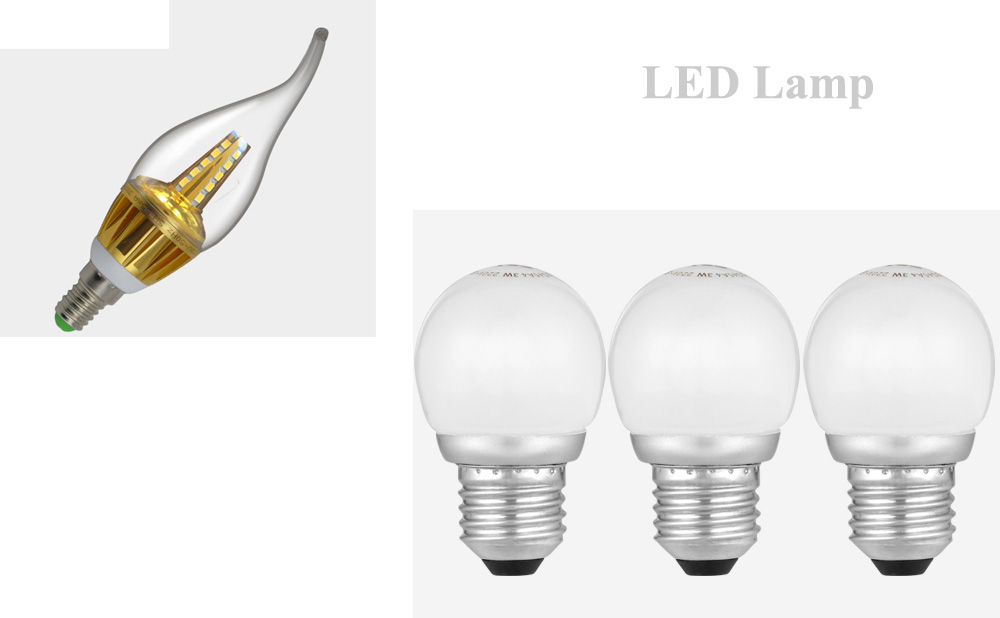
-
LED lights are presented in the photo.
Introduction
-
LED (light-emitting diode) contains two terminals known as anode and cathode, the anode terminal should be put at a higher potential than cathode terminal. The LED will be light on when current flows from anode to cathode.
LED can directly emit red, yellow, blue, green, cyan, orange, purple, and white light.
Initially, LEDs were used as indicator lights for instruments and meters in the field of telecommunication and electrical engineering. Later, LEDs of various light colors were widely used in traffic signal lights and display screens.
Details
-
In the 1960s, scientific and technological workers created LED light-emitting diodes based on the principle of semiconductor PN junction light.Made of GaASP, the early LED was only available in red color. After more than 30 years of development, red, orange, yellow, green, blue and other colors' LED are available. The white LED for lighting is not available before 2000.
Application
-
LED lights can be used in variety fields ranging from computer mother-board, automotive lamps, camera flashes, traffic signal, billboard, aviation lighting, medical devices etc. It is on the way to replace most incandescent lights.
- Initially, LED was used as a light source indicator for instrumentation.
- LED has been widely used in traffic signal lights, and has produced good economic and social benefits.
- Automotive signal lights:
High-position brake LED lights on vehicle is helpful to avoid rear-end collisions, because of the fast response of LED.
- Exterior lighting of building: Many buildings do not have enough space for traditional floodlights. LED light is small, easy to be installed and integrated with the building surface.
- Interior lighting in commercial building: Counter sales area, closet sales area, cashier area, passage area, etc.
- Landscape lighting:
Do not need glass bulbs like traditional lamps, LED can be easily combined with urban streets, paths, stairs, decks, waterfronts, gardening and even flowers or low shrubs. Concealed LED lights is becoming popular.
- Signs and Indicative Lighting :
LED is can be embedded in vertical walls or ground for guidance in limited space, such as the separation display of roads or pavements, stair steps lighting, emergency exit indicator lighting, ground guide lights in the auditorium of the theater or the indicator lights on the side of the seats, and the guide lights on the floors in the shopping center.
- Stage lighting :
Compared with PAR lights, LED do not have heat radiation, which can make the stage more comfortable.
Based on digital controlling of color brightness and dimming, LED can create static and dynamic lighting effects.
- Outdoor display
LED is available to be used in red, green, blue and even full color outdoor display. The full-color LED screen is an eye-catching outdoor display device.
Adopting advanced digital video processing technology, LED outdoor screen can be made in super large scale with super high brightness.
- Road indicator
LEDs are widely used as indicator lights and lighting in areas such as urban traffic and highways.
- Mini flashlight
LEDs are used in keychain-type miniature flashlights, bringing convenience to people's work and life.
Parts and Components
-
The LED lamp is an electroluminescent semiconductor material chip, which is cured on the bracket with silver glue or white glue, and then connects the chip and the circuit board with a silver wire or gold wire. The surrounding is sealed with epoxy resin to protect the inner core wire. Function, finally install the shell, so the LED lamp has good seismic performance.
The pn-junction is nothing but a combination of both N-type and P-type semiconductor materials. The material forming the junction diode is not identical to other mainstream didoes, as it comes with a transparent package, allowing the infrared and visible light to pass through the junction.
Classification
-
According to using place, LED lights can be divided into two parts: indoor lighting and outdoor lighting.
It can be divided into red, green, blue and white based on the light color.
Divided by usage, LED covers lighting type and indicating type.
Advantages
-
Being an ideal light source to replace traditional light, LEDs have a wide range of uses and many advantages:
- Very small and very light: LED is basically a very small chip encapsulated in epoxy resin.
- Eye protecting: Ordinary lights are driven by AC, which will inevitably produce stroboscopic. The LED is DC driven, no flicker.
- Energy saving: With voltage of 2-3.6V, working current 0.02-0.03A and power within 0.1W, the power consumption of LED is very low.
- High luminous efficiency: Compared with other lights with effect from 10 to 140, the efficiency of LED can reach 200 lumens/watt. And it can directly emit colored visible light without filtering.
- Fast response: LED has a fast response speed and can be operated at high frequencies.
- Long life: The service life of LED can reach 100,000 hours, which is more than 10 times the service life of traditional light sources.
- Environmental protection: LEDs are made of non-toxic materials and do not contain harmful elements such as mercury and xenon, which is conducive to recycling.
- Not easy to be damaged: Completely encapsulated in epoxy resin, LED can withstands high-strength mechanical shock and vibration. And the maintenance cost of LED is very low.
- Environmental protection : Using cold light source and low glare, LED works with no radiation, and no harmful substances.
- Multi-color: Providing primary colors of red, green and blue, with the help of computer, LED is available to make the three colors have 256 gray levels and mix them arbitrarily to produce 256X256X256 (16777216) colors to form different colors. The combination can realize a variety of dynamic effects and various images.
- High-tech: Compared with the luminous effect of traditional light sources, LED can be integrated with computer, network communication, image processing and embedded control technology.
- Flexible: LED can be made into light, thin and short products in various forms of points, lines or surfaces;
- Imitating sunlight : white light LED is undoubtedly the most advanced technology of LED. Similar with sunlights, the white-color-light LED reflect the real color of the illuminated object.
Disadvantage
-
Heat dissipation: Life of LED will be greatly shortened if the heat dissipation not good.
The price of LED is relatively high.
The carrying current of LED is large although the voltage is low. The input current of a large 1W LED single lamp is 350mA.
There is a big difference between the real using life and the theoretical life.
There is still heat generated although it is in a low level.
The LED's ability of illuminating room is not better than other lights, because of the strong directivity features. This means the high brightness of LED is only available in a narrow angle, and The light will quickly weaken after deviating from this angle.
If the internal connecting lead of one LED disconnected, other LED lamps will be affected.
There is still great space to be improved in power saving of LED.
History
-
LED is not a new device, it has long been serving in the field of telecommunication, electrical engineering.
Based on the principle of semiconductor P-N junction light emission, the first LED light was created in the early 1960s. Made in GaAsP, the LED emits red light (λp=650nm) with optical efficiency at 0.1 lumens/watt.
The first LED (red) was created in 1969.
In the mid-1970s, the elements IN and N were used to make the LED produce green light (λp=555nm), yellow light (λp=590nm) and orange light (λp=610nm), and the optical efficiency was increased to 1 lumens/watt.
Green LED light appeared in 1976.
In the early 1980s, GaAlAs LED light appeared, making the luminous efficacy of red LED reach 10 lumens/watt.
In the early 1990s, GaAlInP(emitting red and yellow light) and GaInN (emitting green and blue light) were created, which greatly improved the optical efficiency of LED.
Blue LED light appeared in 1993.
White LED light appeared in 1999.
In 2000, the LED reached luminous efficiency of 100 lumens/watt, and in this year, the LED was used in indoor lighting.
Note
-
LED does not work when positive and negative poles are connected incorrectly.
The LED can be wiped and dipped in ethanol for no more than 3 minutes.
It means there is a problem if the LED flashes quickly or there is a sound when LED work.
Waterproof capability is different for outdoor and indoor LED lights.
Tips
-
Keep heat dissipation of LED in a good condition, because the life of the lamp will be greatly reduced in high temperature.
Choose a well-ventilated, no corrosive gas, no combustibles and less dust places to install LEDs.
Keep LED far from static electricity.
LED need to work under the same current level, the general current is 15-20mA.
- Connect buyers with suppliers.
- Home | Copywright @ SupplierV.com